 Оновлено: 17.12.2025
 In today’s textile industry, there are many methods of printing on clothes, among which sublimation and digital printing are two of the most popular. These methods have their own unique characteristics, advantages and limitations that determine their application in different settings and for different purposes. In this article, we will take a detailed look at the main differences between sublimation and digital printing on clothes.
Features of sublimation printing
Sublimation printing is a process in which the image is transferred to the material with the help of special paints, which, under the influence of high temperature, change from a solid state to a gaseous state, bypassing the liquid phase. This gaseous dye penetrates the fibers of the fabric, creating a bright and wear-resistant image.
The main stages of sublimation printing
The process of drawing an image takes place in several stages.
- Image preparation. Create or select an image to print.
- Print image. Image printing on special sublimation paper using sublimation inks.
- Image transfer. Transferring the image from paper to fabric using a heat press that heats the material to a temperature of about 200°C.
Advantages of sublimation printing
- Quality and durability. Sublimation dyes penetrate the fibers of the fabric, which ensures high resistance to wear, fading and washing.
- Brightness of colors. Sublimation printing allows you to get bright and saturated colors, which makes it ideal for creating colorful images and designs.
- Detailing. High resolution allows you to convey small details and color gradations.
- Seamless image. The image becomes part of the fabric, which prevents cracks or peeling.
Limitations of sublimation printing
- Fabric type. Sublimation printing is mostly suitable for synthetic materials such as polyester and is not suitable for natural fabrics such as cotton.
- Fabric color. The best results are achieved on white or light-colored fabrics, since the dyes cannot cover the dark color of the base.
What is special about digital printing?
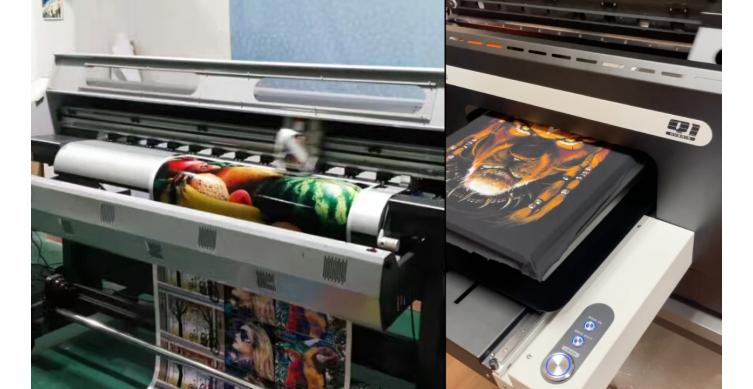
Digital printing (Direct to Garment, DTG) is a method in which the image is printed directly on the fabric using a special inkjet printer. This method allows you to create high-quality images with a wide range of colors.
Stages of application
Like the previous method, this one also takes place in several stages.
- Image preparation. Create or select a digital image.
- Fabric preparation. Application of a special primer on the fabric to improve paint adhesion.
- Print image. Direct printing of the image on the fabric using an inkjet printer that uses textile dyes.
- Image capture. Fixing the image on the fabric using a heat press or a drying unit.
Advantages of digital printing
- Versatility. Digital printing can be applied to different types of fabrics, including natural ones such as cotton, linen, silk and synthetics.
- Color options. Digital printing allows you to reproduce images with high accuracy and a wide color range, including gradients and photographic quality.
- Small editions. This method is cost-effective for small and one-off orders because it does not require the creation of printing forms or stencils.
- Speed. The printing and preparation process takes less time compared to other methods.
Limitations of digital printing
- Durability. Although digital printing provides good image quality, its durability can be lower than that of sublimation printing, especially after many washing cycles.
- Expenses for consumables. Inks for digital printing can be more expensive, which affects the overall cost of the product.
- Preliminary preparation of the fabric. To obtain optimal results, careful preparation of the fabric is necessary, taking into account the application of the primer.
Comparison of sublimation and digital printing
An analysis based on several criteria will help decide on a printing method.
Image quality
Sublimation printing ensures high image quality due to the penetration of dye into the fibers of the fabric, which makes the image bright and resistant to wear. Digital printing also offers high quality, but may have limitations in image durability after many washes.
Types of fabrics
Sublimation printing is only suitable for synthetic fabrics such as polyester. Digital printing, on the other hand, is versatile and can be used on many different types of fabrics, including natural and synthetic materials.
Cost
Sublimation printing can be more economical for large runs because it requires less preparation costs. Digital printing is more flexible for small and one-off orders, but can be more expensive due to the cost of inks and preparation materials.
Color options
Both methods offer a wide range of colors, but sublimation printing is characterized by particular brightness and saturation. Digital printing allows for accurate rendering of gradients and photographic quality, making it ideal for complex images.
Durability
Sublimation printing is known for its high resistance to washing and wear due to the penetration of the dye into the fibers of the fabric. Digital printing can have a lower durability, especially if the fabric is subjected to frequent washing and mechanical effects.
Use in the textile industry
Sublimation printing is a popular choice for sportswear due to its durability and ability to convey vibrant colors. It is ideal for printing logos, numbers and other elements on synthetic fabrics such as polyester, often used in sportswear.
Digital printing is widely used in the fashion industry due to its versatility and ability to print on different types of fabrics. It allows you to create unique designs and use complex images, making it a popular choice for designers and clothing manufacturers.
Both printing methods find their application in the creation of advertising products, such as T-shirts, bags and other textile products. The choice of method depends on image quality requirements, fabric type and budget.